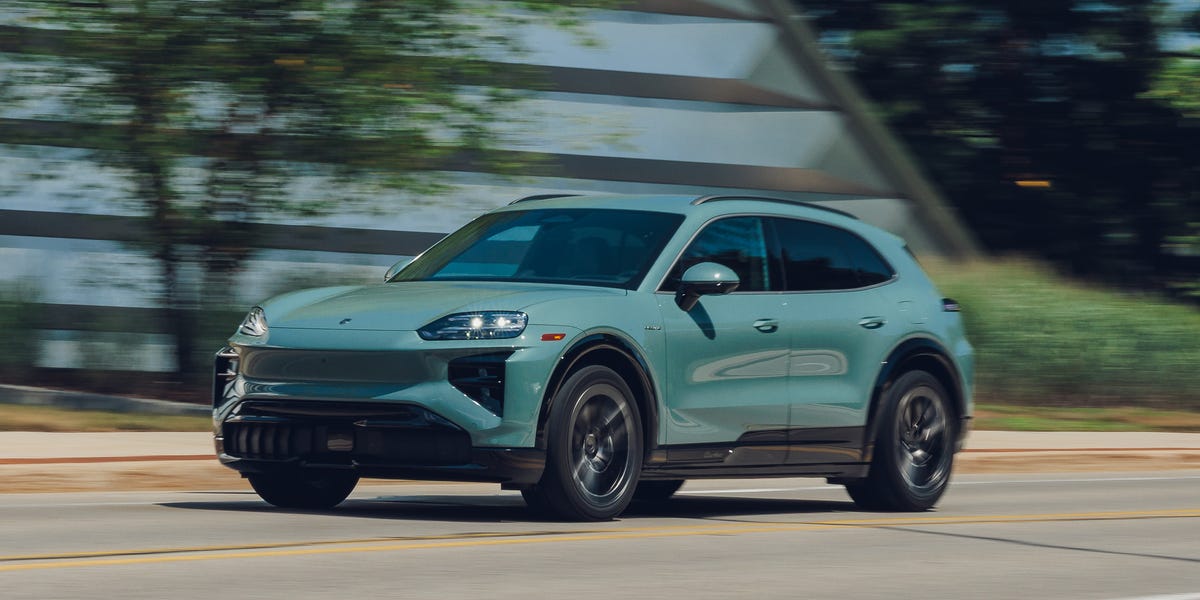
Performance That Defies Physics
The numbers read like a typo. Zero to 60 mph in 2.1 seconds with launch control. Zero to 100 mph in 4.5 seconds. A top speed run of 160 mph completed in 11.7 seconds. For context, that 0-60 time puts the Cayenne Turbo Electric in the same breath as the quickest production cars ever built, including the Tesla Model S Plaid and the Lucid Air Sapphire, and it does so while weighing nearly three tons.
The physics-defying part is how the SUV handles the quarter-mile. The 911 Turbo S actually holeshots the Cayenne Turbo Electric, beating it to 60 mph by 0.1 second. But by 100 mph the Cayenne Turbo Electric has already passed it, and it keeps pulling. That is the signature of electric power delivery: not just a violent launch, but relentless acceleration across the entire speed range. The Cayenne Turbo Electric set new SUV records in Car and Driver testing for the quarter-mile, skidpad, and 70-0 mph braking. It also beat the 911 Turbo S in the 0-150-0 test, which measures acceleration and braking together.
Power Delivery: 844, 1,018, or 1,139 HP
The Cayenne Turbo Electric does not have one power figure. It has three, and understanding them explains how the SUV achieves its numbers.
In default mode, the dual-motor all-wheel-drive system produces 844 horsepower. Press the push-to-pass button on the steering wheel and output jumps to 1,018 hp for 10 seconds, cutting the 30-50 mph sprint from 1.1 seconds to 0.9 and the 50-70 mph pass from 1.4 seconds to 1.1. Then there is launch control, which unleashes the full 1,139 hp and delivers that 2.1-second run to 60.
An electronically controlled limited-slip differential manages the power, and the chassis carries a 52.9 percent rear weight bias, which helps the SUV rotate under throttle. There is one charming detail for traditionalists: the start button still sits to the left of the steering wheel, a vestigial nod to Porsche’s Le Mans heritage. There is no engine to start, but the ritual remains.
Range, Charging, and Battery
For all its drag-strip heroics, the Cayenne Turbo Electric still has to function as an electric vehicle, and here the specs matter just as much as the horsepower. Porsche equips the Cayenne Turbo Electric with a 113 kWh battery pack, and the EPA rates it at approximately 300 miles of range. That figure trails the gas-powered Cayenne’s highway cruising distance, but it is competitive for a performance SUV of this size and weight.
Charging speed is where the Cayenne Turbo Electric claws back ground. The 800-volt architecture supports DC fast charging at up to 400 kW, which can take the battery from 10 to 80 percent in roughly 18 minutes under ideal conditions. That is among the fastest charging rates of any production SUV on the market, and it makes long-distance travel far less painful than the range figure alone might suggest. An 11 kW onboard charger handles home AC charging overnight.
The trade-off is familiar to anyone shopping performance EVs. You get supercar acceleration and SUV practicality, but you pay for it at the plug and in reduced range compared to a gas Cayenne. For buyers cross-shopping this against a 911 Turbo S, the calculus is different. The 911 is a dedicated sports car with no pretensions of family duty. The Cayenne Turbo Electric asks you to accept charging stops in exchange for doing everything else.
Records and Rivalries: Beating the 911 Turbo S
The comparison with the 911 Turbo S deserves its own section because it reframes what the Cayenne Turbo Electric is.
The Cayenne Turbo Electric beats the 911 Turbo S in the quarter-mile by 0.2 seconds and 4 mph. It beats it in the 0-150-0 test. And its 70-0 mph braking distance of 140 feet matched the last 911 Carrera GTS coupe and the Chevrolet Corvette ZR1 that Car and Driver tested. This is not a case of an SUV being fast for an SUV. This is an SUV being fast, full stop.
According to Car and Driver, the Cayenne Turbo Electric is also only the second Porsche model, after the Taycan, to outperform the 911 Turbo S in instrumented testing. That fact alone signals where Porsche believes its performance future lies, and it raises an uncomfortable question for the brand’s most loyal customers: if the flagship SUV is quicker than the flagship sports car, what exactly is the 911 Turbo S selling?
Chassis and Braking: Cornering and Stopping Power
Straight-line speed is only half the story. The Cayenne Turbo Electric rides on Pirelli P Zero R summer tires mounted to 22-inch forged-aluminum wheels, and it pulled 1.05 g on the skidpad, a new SUV record in the test.
Optional carbon-ceramic brakes measure 17.3 inches up front with 10-piston calipers and 16.1 inches at the rear with four-piston units. Porsche Active Ride uses electrically driven hydraulic pumps to control pitch and roll, and rear-axle steering is available to tighten low-speed maneuverability and stabilize high-speed lane changes.
The chassis defaults to understeer, which is the safe and predictable choice for a vehicle this heavy. But the throttle can rotate the rear, giving the Cayenne Turbo Electric controllable oversteer when the driver asks for it. It is a setup that rewards skill without punishing mistakes, which is exactly what a 5,960-pound SUV needs.
Interior and Daily Usability
Step inside and the Cayenne Turbo Electric is not a carbon copy of the gas-powered Cayenne. The cockpit is entirely digital, with no physical tachometer, which makes sense in a car with no engine to rev. Sport seats carry embossed details, a wrist rest sits below the curved central display, and motorized rear-window privacy shades add a touch of executive comfort.
Practicality remains intact. Five seats, a 7,716-pound towing capacity, and a ride in Comfort mode that borders on luxury. Car and Driver noted that broken pavement “arrives as texture instead of impact,” which is high praise for a vehicle riding on 22-inch wheels and summer tires.
Pricing and Options: What You Get for $165,350
The Cayenne Turbo Electric starts at $165,350. The test car came in at $194,600, with just over $20,000 of that spent on performance options: rear-axle steering, Porsche Active Ride, carbon-ceramic brakes, and summer tires.
What the test car notably lacked is equally telling. No sunroof. No four-zone climate control. No thermally and acoustically insulated glass. Those omissions suggest Porsche understands who is buying this vehicle. The Cayenne Turbo Electric is not positioned as the ultimate luxury Cayenne. It is positioned as the ultimate performance Cayenne, and the options sheet reflects that priority.
Driving Impressions: Beyond Raw Acceleration
The most revealing detail in the entire test came on day three. By then, Car and Driver reported, acceleration had become “the least interesting part of the driving experience.” Supercar performance had been relegated to “just another feature” alongside luxury and utility.
That is a remarkable shift. The steering is accurate and expertly weighted. The brake pedal is easy to modulate, and the handoff from regenerative to friction braking is nearly imperceptible. Porsche does not offer true one-pedal driving, and the sole brake-regen setting “feels largely ceremonial,” which is a polite way of saying it does almost nothing.
What remains is a vehicle that does everything well. It tows. It cossets. It corners. And when the road opens up, it delivers acceleration that would have been unimaginable in an SUV a decade ago.
The Future of Performance SUVs
The 2026 Porsche Cayenne Turbo Electric sets a new benchmark, but the more interesting question is what it signals about Porsche’s broader strategy. The company now has two electric models, the Taycan and the Cayenne Turbo Electric, that outperform the 911 Turbo S in instrumented testing. The pattern is not accidental. Porsche is betting that its performance halo will increasingly come from EVs, and the Cayenne Turbo Electric is the clearest evidence yet that the bet is paying off.
What that means for the 911 is an open question. The sports car will always have advantages the SUV cannot match: lighter weight, lower center of gravity, a soundtrack, and a purity of purpose that no family hauler can replicate. But in the one metric that generates headlines and showroom traffic, raw acceleration, the SUV has won.
The Cayenne Turbo Electric proves that weight, the traditional enemy of performance, can be managed with enough power, enough grip, and enough engineering. It proves that an SUV can be a record-breaker without sacrificing the utility that justifies its existence. And it proves that electric performance is not a compromise but a different kind of advantage.
For buyers with $165,350 and a taste for contradiction, the Cayenne Turbo Electric offers something no 911 can: a 1,139-horsepower machine that will outrun the 911 Turbo S on Saturday and haul the family on Sunday. That is not just a fast SUV. That is the future of performance, arriving earlier than anyone expected.