Toyota Hilux FCEV: Why Hydrogen, Electric, and Diesel Will Coexist
Toyota’s approach to zero-emission mobility has always been pluralistic. Rather than declaring a single winner in the powertrain wars, the company has invested in hybrids, battery-electric vehicles, hydrogen fuel cells, and even hydrogen combustion. The Toyota Hilux FCEV is a perfect expression of that philosophy.
At the IAA Transportation show in Hannover, Germany, Toyota laid out its European light commercial vehicle strategy with unusual clarity. The company stated plainly that “a single technology solution cannot address the business requirements, mobility needs or the local operating environments of all customers.” That is corporate speak for a simple truth: a builder in rural Norway has different needs than a delivery fleet in central London.
The Hilux range will therefore offer three distinct powertrains. The mild-hybrid diesel remains the workhorse, capable of running on renewable fuels like HVO to cut carbon emissions without sacrificing range or refueling speed. The fully electric Hilux BEV targets urban and suburban operators with predictable routes. And the Toyota Hilux FCEV, arriving in 2028, aims squarely at customers who need serious towing capacity, long range, and fast refueling, but who also want zero tailpipe emissions.
Toyota Hilux FCEV vs. Hilux BEV: Range, Towing, and Refueling Compared
The numbers tell a compelling story about where each powertrain excels.
- WLTP range: Hilux FCEV (target) over 400 km (248 mi) vs. Hilux BEV 257 km (159 mi)
- Towing capacity: Hilux FCEV 2,500 kg (5,512 lbs) vs. Hilux BEV 1,600 to 2,000 kg (3,530 to 4,410 lbs)*
- Refueling time: Hilux FCEV as little as 5 minutes vs. Hilux BEV varies significantly by charger and conditions
*Depending on configuration and regulations.
The Toyota Hilux FCEV’s projected range of over 400 kilometers on the WLTP cycle far exceeds the BEV’s 257 kilometers. More importantly for commercial users, the hydrogen Hilux can tow up to 2,500 kilograms, comfortably ahead of the electric version’s 1,600 to 2,000 kilogram limit. And then there is refueling: five minutes at a hydrogen pump versus a charging session that, even on DC fast chargers, will take considerably longer and depends heavily on charger output, battery state, and ambient conditions.
For fleet operators who bill by the hour, those differences are not trivial. They are the difference between a truck that works and a truck that sits idle.
Prototype Development: From Mirai Tech to 10 UK Test Mules
The Toyota Hilux FCEV did not appear from nowhere. Toyota has been quietly developing the concept for years.
In 2022, the company revealed its first Hilux H2 prototype, essentially a testbed that shoehorned the fuel cell powertrain from the Mirai sedan into a pickup body. That early experiment proved the concept was viable, but it was far from production-ready.
By 2024, Toyota had built 10 FCEV prototypes for real-world testing in the United Kingdom. These were far more sophisticated. Engineers integrated three hydrogen tanks within the Hilux’s ladder-frame chassis, preserving the truck’s structural integrity and off-road capability. A lithium-ion battery was tucked under the rear bed, and a rear-mounted electric motor delivered 180 horsepower (134 kW) and 300 Nm of torque.
Those UK test mules achieved a remarkable 600 kilometers (373 miles) of range in prototype form, significantly more than the 400-kilometer target for the production version. That gap likely reflects the difference between optimistic prototype testing and conservative production specifications, or perhaps the production model will be heavier and more feature-laden. Either way, this roughly 200-kilometer gap is typical in automotive development, where prototype figures are often achieved under ideal conditions and production models must account for real-world variables like payload, weather, and regulatory testing cycles.
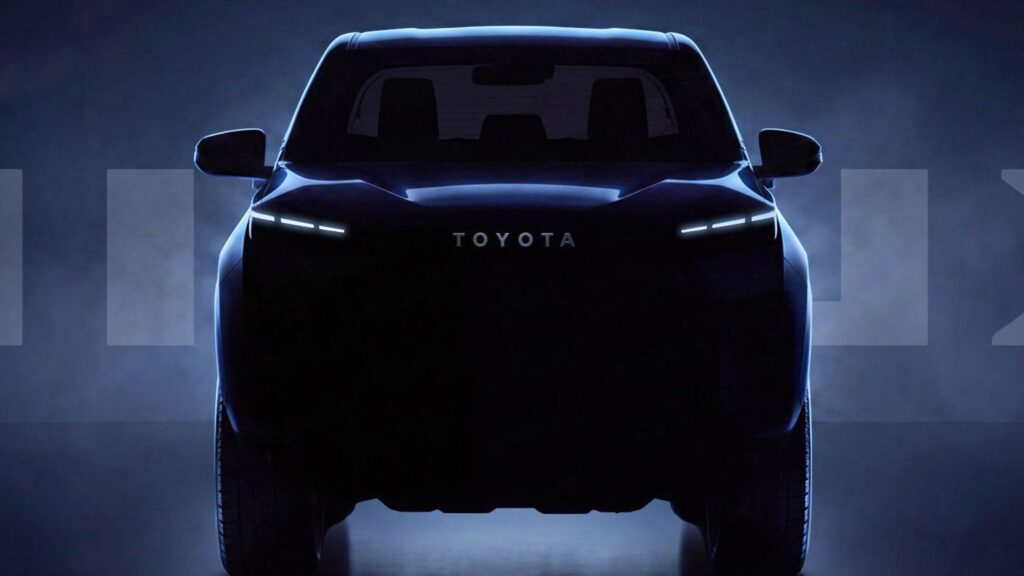
The first official teaser image of the production Toyota Hilux FCEV has also been released. It shows a distinctive lighting signature with segmented daytime running lights, though the overall styling remains shrouded in darkness. It is unclear whether the FCEV will adopt the BEV’s closed-off grille and unique bumper, or retain more of the standard Hilux’s traditional look.
The Hydrogen Infrastructure Challenge: 179 Stations and Counting
Here is where the hydrogen dream runs into hard reality.
According to the European Hydrogen Observatory, there are currently just 179 operational hydrogen refueling stations across Europe and the UK. That is not nothing, but it is a rounding error compared to the continent’s tens of thousands of petrol stations and rapidly growing network of EV chargers.
For a commercial fleet, that limited infrastructure is a serious constraint. A Toyota Hilux FCEV might be perfect for a delivery company operating in a region with reliable H2 access, but it would be a liability for anyone whose routes stray beyond those corridors. Toyota is well aware of this. The company has consistently positioned FCEVs as complementary to BEVs, not replacements for them.
The infrastructure picture is improving, albeit slowly. Germany, France, and the Netherlands have the densest networks, and several hydrogen corridors are being developed for heavy trucks. But until refueling stations become as common as diesel pumps, the Toyota Hilux FCEV will remain a niche product for a specific type of customer.
Pricing Puzzle: Will the Toyota Hilux FCEV Be Affordable?
Toyota has not announced pricing for the Toyota Hilux FCEV, and that silence is telling.
Hydrogen fuel cell vehicles are expensive to build. The fuel cell stack itself relies on platinum and other costly materials. The high-pressure hydrogen tanks are complex and heavily engineered. And because production volumes will be tiny compared to diesel or even BEV variants, Toyota cannot spread development costs across millions of units.
The Mirai, Toyota’s only current FCEV, is priced significantly higher than comparable combustion models in European markets. A hydrogen Hilux, with its larger chassis, three tanks, and commercial vehicle durability requirements, will likely cost considerably more than a comparable diesel or electric Hilux.
While official pricing is unknown, expect the FCEV to carry a significant premium over the already-expensive BEV variant, likely placing it in a price bracket where the total cost of ownership only works for high-utilization fleets. That puts the Toyota Hilux FCEV in an awkward position. It offers genuine advantages in range, towing, and refueling speed, but those advantages come at a premium. Fleet managers will need to calculate whether the productivity gains from faster refueling and higher towing capacity justify the higher sticker price and the limited refueling network.
For some, the math will work. For many, it will not.
What This Means for Fleet Operators
If your fleet operates in Germany, France, or the Netherlands and requires maximum towing capability with minimal downtime, the Toyota Hilux FCEV is worth watching closely. Those markets have the densest hydrogen refueling networks in Europe, and the FCEV’s five-minute refueling and 2,500-kilogram towing capacity could deliver real productivity gains for high-utilization operations.
If your routes fall outside those hydrogen corridors, the calculus changes entirely. The Hilux BEV makes more sense for predictable urban and suburban routes where charging can be planned into the daily schedule. And for operations that need maximum flexibility with an immediate carbon reduction path, the HVO-compatible mild-hybrid diesel remains the most practical choice today.
The key variable is utilization. The higher the daily mileage and the heavier the towing load, the stronger the case for hydrogen. For lower-intensity operations, the premium will be hard to justify.
Toyota’s European LCV Offensive: Sales Growth, Proace Vans, and Zero-Emission Goals
The Toyota Hilux FCEV is just one piece of a much larger puzzle. Toyota’s European light commercial vehicle business is growing rapidly, and the company has ambitious plans.
LCV sales in Europe have more than doubled over the past five years. Toyota projects over 165,000 units in 2026, capturing more than 7 percent market share. By 2030, the goal is 200,000 annual LCV sales and 8 percent market share.
The lineup is a mix of in-house development and strategic partnerships. The Hilux is developed internally, which gives Toyota full control over its engineering and positioning. The compact, medium, and large Proace vans, by contrast, are sourced from Stellantis as part of a long-standing collaboration.
Toyota now offers BEV versions across its entire LCV range. Zero-emission models already account for 22 percent of its LCV sales, double the market average of 11 percent. That is a strong performance, and it suggests Toyota’s customers are receptive to electrification when the product fits their needs.
But Toyota is not abandoning diesel. The company continues to offer diesel powertrains capable of running on renewable fuels like HVO, arguing that these provide an immediate carbon reduction path for customers who cannot yet switch to zero-emission options.
A Niche Bet That Could Pay Off
The Toyota Hilux FCEV is not going to outsell the diesel Hilux. It is not going to outsell the electric Hilux either. But that is not the point.
Toyota is betting that a meaningful slice of the commercial vehicle market needs something that neither diesel nor batteries can fully provide: zero emissions, long range, high towing capacity, and fast refueling. For those customers, the Toyota Hilux FCEV could be the only game in town.
The challenges are real. Hydrogen infrastructure remains sparse. Costs will be high. And the business case will only work for a subset of operators. But Toyota has never been afraid to play the long game. The company spent decades developing hybrids before they became mainstream. It has kept the Mirai alive through years of slow sales. And now it is applying that same patience to hydrogen pickups.
If the infrastructure grows and costs come down, the Toyota Hilux FCEV could look prescient. If not, it will remain a fascinating footnote in the history of zero-emission commercial vehicles. Either way, Toyota is giving customers a choice, and in a market as diverse as European light commercial vehicles, that might be the smartest strategy of all.